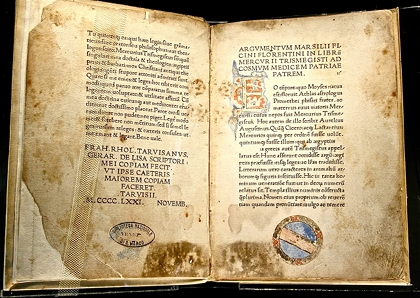
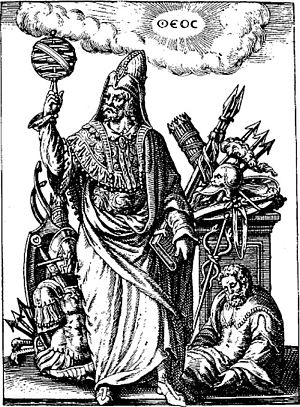
Hermes Trismegistus
The Dial, Vol. IV, No. III (January 1844)
A foundational English introduction to the Corpus Hermeticum: revelatory dialogues on mind, cosmos, and spiritual regeneration, long central to Renaissance and later esoteric theologies.
The following appeared in The Dial, Vol. IV, No. III (January 1844)
We subjoin a few extracts from the old English translation (by Doctor Everard, London, 1650,) of the Divine Pymander of Hermes Trismegistus. The books ascribed to Hermes are thought to have been written, or at least interpolated, by the new Platonists in the third or fourth century of our era. Dr. Cudworth (Intellectual System, Vol. II. p. 142, Lond. 1820,) thinks them to be for the most part genuine remains of the ancient Egyptian theology, and to have been translated by Apuleius. The book deserves, on account of the purity and depth of its religious philosophy, an honorable place among ethical writings.
Good is voluntary or of its own accord; Evil is involuntary or against its will.
The Gods choose good things as good things.
Nothing in heaven is servanted; nothing upon earth is free. Nothing is unknown in heaven, nothing is known upon earth. The things upon earth communicate not with those in heaven. Things on earth do not advantage those in heaven; but all things in heaven do profit and advantage the things upon earth.
Providence is Divine Order.
What is God and the Father and the Good, but the Being of all things that yet are not, and the existence itself of those things that are?
The sight of good is not like the beams of the sun, which being of a fiery shining brightness maketh the eye, blind by his excessive light; rather the contrary, for it enlighteneth and so much increaseth the power of the eye, as any man is able to receive the influence of this intelligible clearness. For it is more swift and sharp to pierce, and harmless withal, and full of immortality, and they that are capable, and can draw any store of this spectacle and sight, do many times fall asleep from the body into this most fair and beauteous vision; which things Celius and Saturn our Progenitors attained unto.
For the knowledge of it is a divine silence, and the rest of all the senses. For neither can he that understands that, understand anything else; nor he that sees that, see anything else, nor hear any other thing, nor move the body. For, shining steadfastly on and round about the whole mind, it enlighteneth all the soul, and loosing it from the bodily senses and motions, it draweth it from the body, and changeth it wholly into the essence of God. For it is possible for the soul, O Son, to be deified while yet it lodgeth in the body of man, if it contemplates the beauty of the Good.
He who can be truly called man is a divine living thing, and is not to be compared to any brute man that lives upon earth, but to them that are above in heaven, that are called Gods. Rather, if we shall be bold to speak the truth, he that is a man indeed, is above them, or at least they are equal in power, one to the other. For none of the things in heaven will come down upon earth, and leave the limits of heaven, but a man ascends up into heaven, and measures it. And he knoweth what things are on high, and what below, and learneth all other things exactly. And that which is the greatest of all, he leaveth not the earth, and yet is above: so great is the greatness of his nature. Wherefore we must be bold to say, that an earthly man is a mortal God, and that the heavenly God is an immortal man.
Ascription
Who can bless thee, or give thanks for thee or to thee?
When shall I praise thee, O Father; for it is neither possible to comprehend thy hour, nor thy time?
Wherefore shall I praise thee,—as being something of myself, or having anything of mine own, or rather as being another's?
For thou art what I am, thou art what I do, thou art what I say.
Thou art all things, and there is nothing which thou art not.
Thou art thou, all that is made, and all that is not made.
The mind that understandeth;
The Father that maketh;
The Good that worketh;
The Good that doth all things. Of matter the most subtile and slender part is air; of the air, the soul; of the soul, the mind; of the mind, God.
By me the truth sings praise to the truth, the good praiseth the good.
O All I receive a reasonable sacrifice from all things.
Thou art God, thy man cryeth these things unto thee, by the fire, by the air, by the earth, by the water, by the spirit, by thy Creatures.
Editorial Note. The text and accompanying audio above present selected passages from this installment as published in The Dial. The complete selection as it appeared in The Dial can be read through the Walden Woods Project.