The Laws of Menu
The Dial, Vol. III, No. III (January 1843)
Sir William Jones's English rendering helped define how many 18th-century European readers first encountered Manu/Manusmṛti as a wide-ranging code of ethics, ritual practice, social order, and penance.
The following appeared in The Dial, Vol. III, No. III (January 1843)
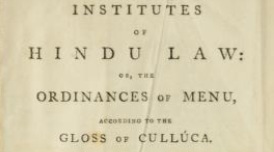
The Laws of Menu (Manusmriti) represent one of the most important ancient Hindu legal texts, traditionally attributed to the sage Manu. The text was translated by Sir William Jones and published in 1794, bringing this foundational work of Hindu jurisprudence and ethics to Western readers.
Let him say what is true, let him say what is pleasing, let him utter no disagreeable truth, and let him utter no agreeable falsehood; this is the eternal law.
By falsehood a sacrifice becomes vain; by pride the merit of devotion is lost; by insulting priests life is diminished; and by publishing a largess its fruit is destroyed.
Single is each man born; single he dies; single he receives the reward of his good, and single the punishment of his evil deeds.
The soul is its own witness; the soul itself is its own refuge; offend not thy conscious soul, the supreme internal witness of men.
O friend to virtue, that supreme Spirit, which thou believest one and the same with thyself, resides in thy bosom perpetually, and is an all-knowing inspector of thy goodness or of thy wickedness.
If the vital soul be in amity with the divine soul, those two spirits sitting as assessors never disagree, his own heart is his internal witness.
Depend not on another; rather lean upon thyself; trust to thine own exertions: subjection to another is pain.
When invited to a religious rite, let him never read or recite the Veda on horseback, nor on a tree, nor on an elephant, nor in a boat, nor on an ass, nor on a camel, nor standing on barren land, nor riding in a carriage, nor during a sermon.
Action, either mental, verbal, or corporeal, bears good or evil fruit as itself is good or evil.
With whatever disposition of mind a man shall perform any act, he shall reap the fruit in a body endued with a similar quality.
A wise man should constantly discharge all the moral duties, though he perform not constantly the ceremonies of religion; he falls low, if, while he performs ceremonial acts only, he discharge not his moral duties.
By the daily study of the Veda, by the worship of the Gods and of the Manes, by the practice of mercy towards all creatures, and by giving to guests the food and raiment obtained by labor.
Let him honor all his food, and eat it without contempt; when he sees it, let him rejoice; and let his soul be cheered when he receives it.
Food eaten constantly with honor, gives muscular force and generative power; but eaten with disrespect, it destroys them both.
Not a guest must drink water, even in the abode of a secular priest, from a vessel used in drinking ardent spirits, though the vessel be made of gold.
Editorial Note. The text and accompanying audio above present selected passages from this installment as published in The Dial. The complete selection as it appeared in The Dial can be read through the Walden Woods Project.